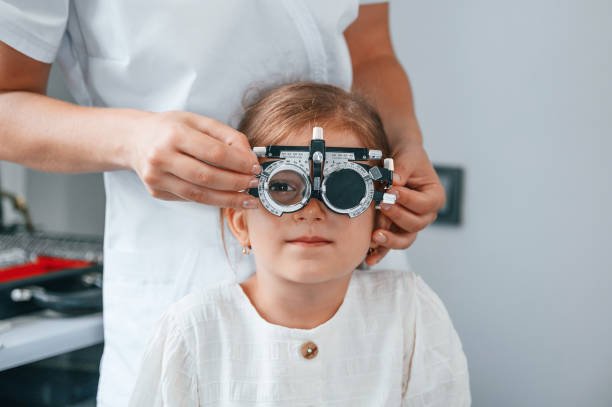
Pediatric Ophthalmology is a very important branch as children use their vision to learn new things during the days of their childhood. Hence identifying and treating these childhood conditions are important as it plays an important role in the development of a child.
At BEH, we treat kids with utmost care as vision plays an important role in shaping their future.
Refractive errors
Refractive errors are eye disorders in which the child would have a problem in viewing far/near objects. These include myopia, hypermetropia and astigmatism. Myopia is a condition in which near objects are seen clearly, but objects that are far away aren’t seen clearly. Hypermetropia is a condition in which objects that are far away are usually seen clearly, but objects that are near aren’t seen clearly. Astigmatism is a condition in which the cornea of your eye is irregular in shape causing distortion or blurring of the image at any distance. Astigmatism usually doesn’t occur alone and occurs with myopia or hypermetropia.
Squint or Strabismus
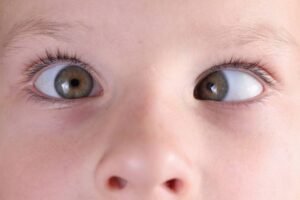
This is a condition in which both the eyes of a person have improper alignment and the eyes point in different directions. The eyes may be turned inwards, outwards, upwards or downwards. Squint can occur at any age. But the problem if squint occurs in childhood is the kid ignores that eye and uses the normal eye almost always, leading to lazy eye of the squinting eye.
Pediatric Cataract
When the clear lens in a child loses its transparency and becomes opaque, it is called pediatric cataract. In children cataract can be of two forms, congenital or developmental. The condition is rare, but is one of the important causes of childhood blindness.
Retinoblastoma
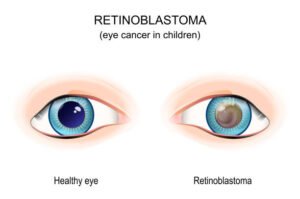
Retinoblastoma is a cancer of the eye that affects children. It is often inherited from affected parents. It starts from the retinal layer of the eye. It is often detected very late as it shows minimal signs and symptoms. As the cancer progresses it is seen as a white mass inside the eye. In later stages, the cancer spreads outside the eye posing danger to life. Multimodal treatment including surgery, laser chemotherapy and radiotherapy are required to halt the progression.